Throughout the last year, global trade was volatile as manufacturers around the world faced challenges such as slowing economic growth, elevated inflation and shipping constraints.
Now, with 2022 behind us, all eyes are looking ahead to see which market forces will be at play this year. I wanted to share with you some of the trends and topics I am monitoring to gauge impact on the 2023 international trading market.
Slowing Global Economy
We saw the global economy start to slow in 2022, but analysts expect us to see greater economic softening in 2023.
The International Monetary Fund (IMF), for example, downgraded 2023 economic growth forecasts in its October 2022 World Economic Outlook Report, stating that we can expect the global economy to expand 2.7% this year. This is lower than the growth estimate of 3.6% in their April 2022 report.
IMF cited factors such as tightening financial conditions, a cost-of-living crisis and softening economic indicators as a reason for their growth downgrade. Additionally, IMF Managing Director Kristalina Georgieva warned that we can expect 2023 to be a tough year for the global economy as the main drivers of global growth – the U.S., E.U. and China – experience weaker activity. Georgieva indicated that we could see nearly one-third of the world’s economies contract in 2023.

Image Courtesy of IMF
Global economic conditions have a major impact on manufacturing demand around the world. A slowing global economy could decrease production output and prompt manufacturers to shift procurement strategies, such as considering international sources for raw materials to reduce production costs.
Inflation Rates to Soften
Global inflation was elevated in 2022, but, due to tighter monetary policies and slowing demand, analysts say we should expect inflation to ease in 2023.
A forecast conducted by FocusEconomics, for example, shows annual inflation rates slowing in nearly every country in 2023. Brazil, which saw an annual inflation rate of 5.9% in November 2022, is expected to see inflation slow to 4.9% by the end of 2023. Mexico, which saw an annual inflation rate of 7.8% in November 2022, is also forecasted to see inflation drop to 4.9% by the end of 2023.
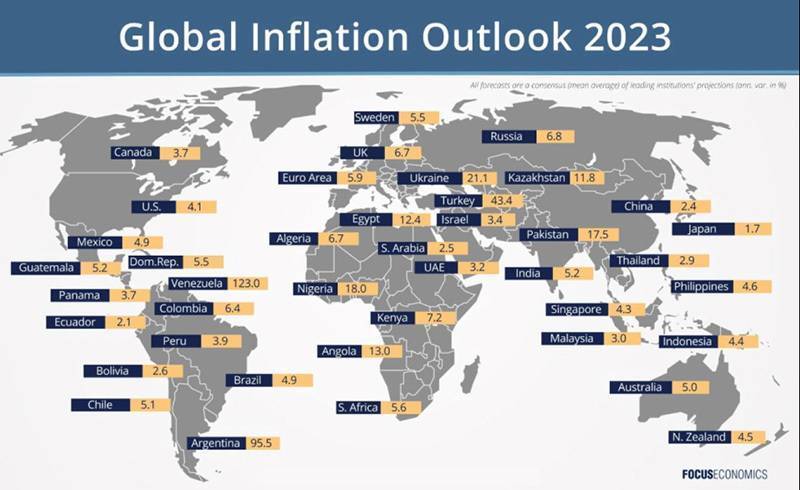
Image Courtesy of FocusEconomics
In their October 2022 World Economic Outlook, IMF stated that we should see global inflation ease to 6.5% in 2023 from 8.8% in 2022. As a result of cooling inflation, analysts expect that we could see some central banks ease their monetary policies in the later part of the year.
Inflation is an area that we at Leeco Trading keep a close eye on due to its direct impact on consumer demand and, therefore, manufacturing. Inflation also has a strong influence on the direction of central bank monetary policies, which have an impact on the overall economy.
Volatile Manufacturing Activity
Manufacturing activity was volatile throughout 2022, both globally and within Latin America, and this is a trend that we expect to see continue during 2023.
Manufacturing PMI has been steadily dropping in Brazil since May 2022, with the latest reading showing that the manufacturing sector is at a level of contraction due to a slowdown in new business and new export orders.
In Mexico, however, we are seeing a lot more fluctuations. Manufacturing PMI rose in the first part of 2022, then dipped during the middle of the year and was on the rise again towards the end of the year, with new orders and production rising.
Nearshoring, or the relocation of manufacturing facilities from Asia back to North America, is a major trend that we could see impact Mexico’s manufacturing sector over the next year. According to Mexico Economy Minister Raquel Buenrostro, more than 400 North American companies intend to relocate their operations from Asia to Mexico. This is a move that could provide a strong boost to Mexico’s manufacturing output and activity.
Brazil Presidential Change
In 2023, we will see a presidential change in Brazil, as the country voted President Luiz Inacio Lula da Silva into office.
With this presidential change will also come a change in economic policy. President Lula has proposed a 168 billion reais ($32 billion) spending plan to meet campaign promises, which include investments in welfare programs, infrastructure and housing. This spending policy differs from former president Jair Bolsonaro, who took a more conservative fiscal approach.
Additional infrastructure investment would increase demand for structural steel and metals products, but economists are concerned that Lula’s spending plan could place upward pressure on inflation.
Navigate Global Trade with a Trusted International Trading Partner
Many analysts agree that economic volatility awaits us in 2023, making it more important than ever for manufacturers to work with a trusted trading partner to find a cost-effective – yet high-quality – source for the raw materials they need.
With over 140 years of experience in moving commodities across the globe, Leeco Trading can use its expertise, value-added services and strong supplier connections to help companies import the materials they need, when they need them.
Contact Leeco Trading to discuss your next project or learn more about our services.